
Most advice about elopement dresses is about what to leave out. Go shorter. Go simpler. Skip the train. The assumption underneath it is that eloping is a smaller version of a wedding, so the dress should be a smaller version of a wedding dress.
That has not been my experience. I have been making gowns in California for fourteen years, and brides who elope aren’t asking for less. They are asking for the same thing every bride asks for, under a completely different set of conditions. The dress still has to feel like the most beautiful thing she has ever worn. It just also has to survive a trailhead, a courthouse step, or a ferry.
Here is what actually changes.
Nobody is going to help you get into it
At a wedding with a getting-ready room, a bridesmaid, a mother, and sometimes a planner are there. Someone is doing up the forty covered buttons down your back. Someone is lacing the corset.
When you elope, that person may not exist. You might be in a hotel room with your partner, who has never done up a wedding dress in his life, or alone with twenty minutes before you meet the officiant.
This is the single most practical thing to check, and the one most brides never think about. A back zip you can reach. A closure that works with one set of hands. If you love a gown with a long button placket, ask whether it has a zip underneath, because most well-made dresses do.
The same goes for the bustle. At a reception, someone bustles you before dinner. Eloping, there is often no reception and no one to do it, which is why many of our elopement brides choose a gown with a short train or no train at all. Not because a train is too much for a small wedding, but because there is nobody to pick it up.
You will probably carry it yourself
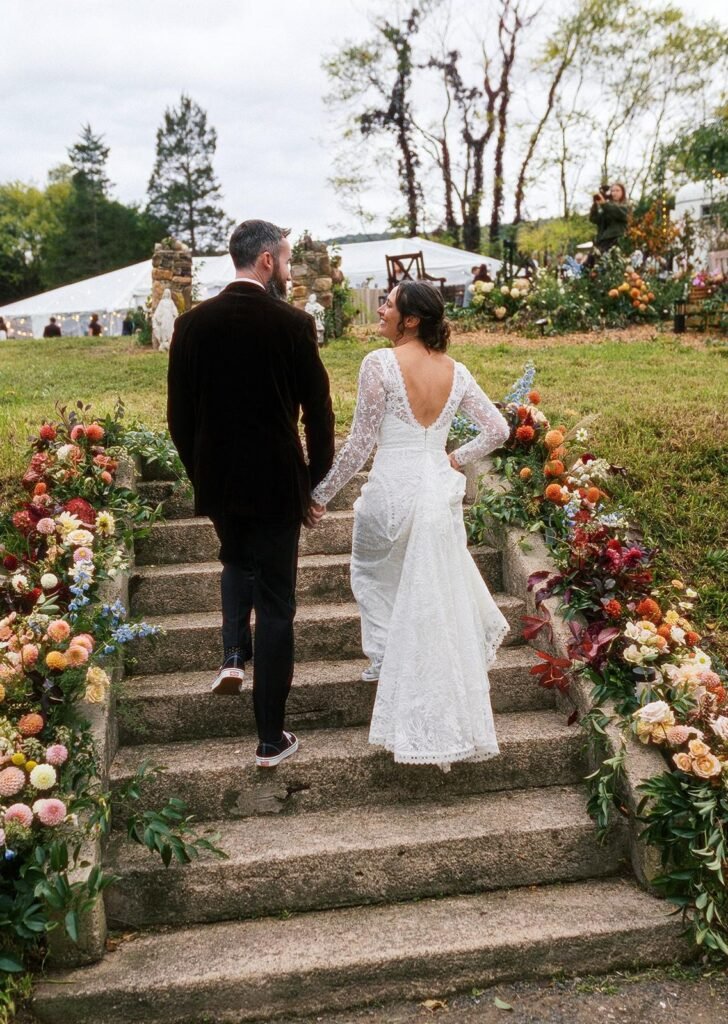
A bride at a hotel wedding walks from a room to a room. A bride eloping gets into a car, out of a car, up a path, over rocks, into a restaurant afterward.
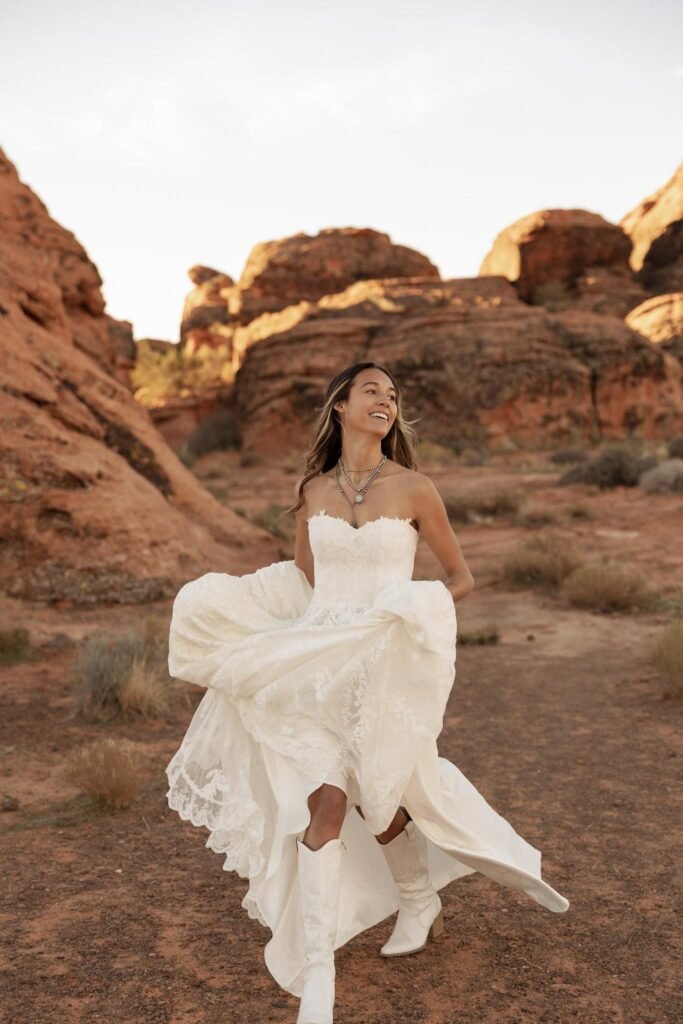
Weight matters more than volume here. Those are not the same thing. A full circle skirt in cotton lace moves beautifully and still has real weight because a circle skirt uses a lot of fabric. A gathered skirt gives you the same fullness through the hip with less hem fabric, so it photographs full and carries light.
If there is any walking at all, that distinction is the one to get right. Our Sierra has pockets, which sounds like a small thing until you are holding your vows, your phone, your lip balm, and a bouquet with two hands on a hiking trail.
The fabric is doing more work than usual
Indoors, climate control handles the weather. Eloping, the weather is the venue.
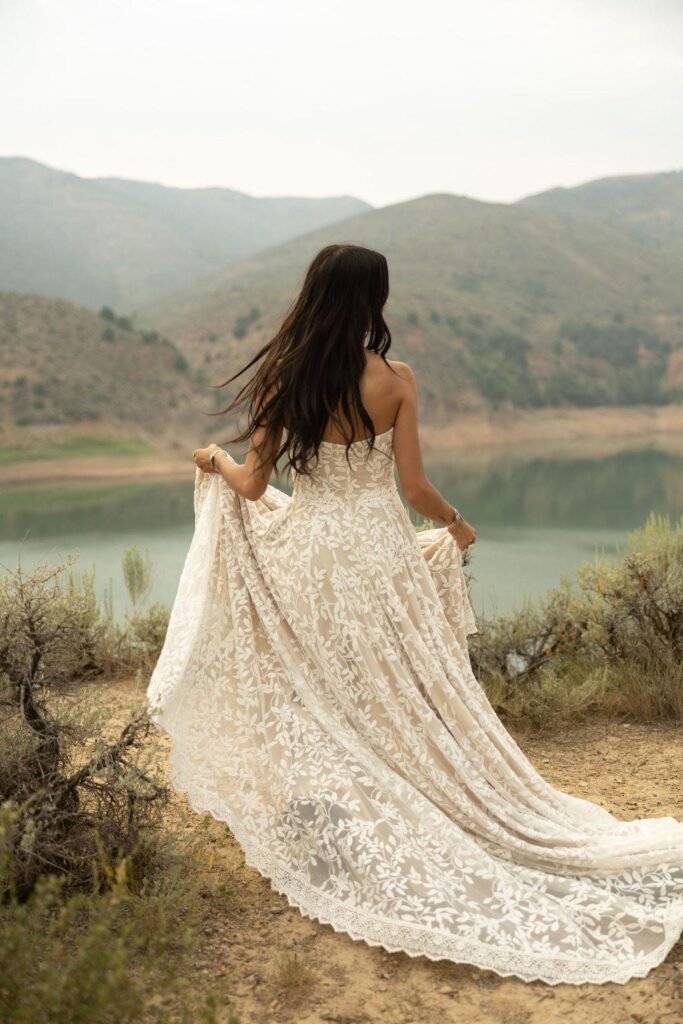
Natural fibers behave better in every direction here. Cotton lace breathes in heat instead of trapping it against the skin, and it falls in the wind instead of ballooning. Synthetic satin holds warmth and shows every mark of humidity. Polyester chiffon is light but clings when the air is damp.
It also matters for what happens to the dress between leaving the hotel and reaching the spot. Cotton folds into a garment bag, travels, hangs in a bathroom overnight, and releases most of its creases on its own. That is a practical advantage when you are flying to the place you are getting married.
There is nowhere to hide a bad hem
A ground-grazing hem works on a flat indoor floor. On grass it catches. On sand it holds damp along the edge for the rest of the day. On stone steps it goes under your heel.
This is where made-to-order genuinely matters, and I say that as someone with an obvious interest in the answer. Most gowns are cut to a standard height and hemmed toward you afterward. If you are shorter than that standard, the extra length goes into the ground. We cut the hem to the bride’s height in the shoes she is actually wearing, which for an elopement is usually flats or boots, and sometimes nothing at all.
Whoever you buy from, ask the question in those terms. Not “can it be hemmed,” but “what height is it cut to, and what shoes are you measuring against.”
You will be in photographs from two feet away
This is the part nobody mentions, and it changes what detail is worth paying for.
At a wedding with 150 guests, your photographer is working the room, and much of the coverage is from a distance. When you elope, it is you, your partner, and a photographer standing close. Most of the frames are intimate.
Beading and crystal are built for a distance and a flash. Up close in daylight, they catch hard. Texture does the opposite. Cotton lace reads as depth in natural light, and the closer the camera gets, the better it looks. That is why so many elopement gowns are lace rather than satin, even when the bride did not set out looking for lace.
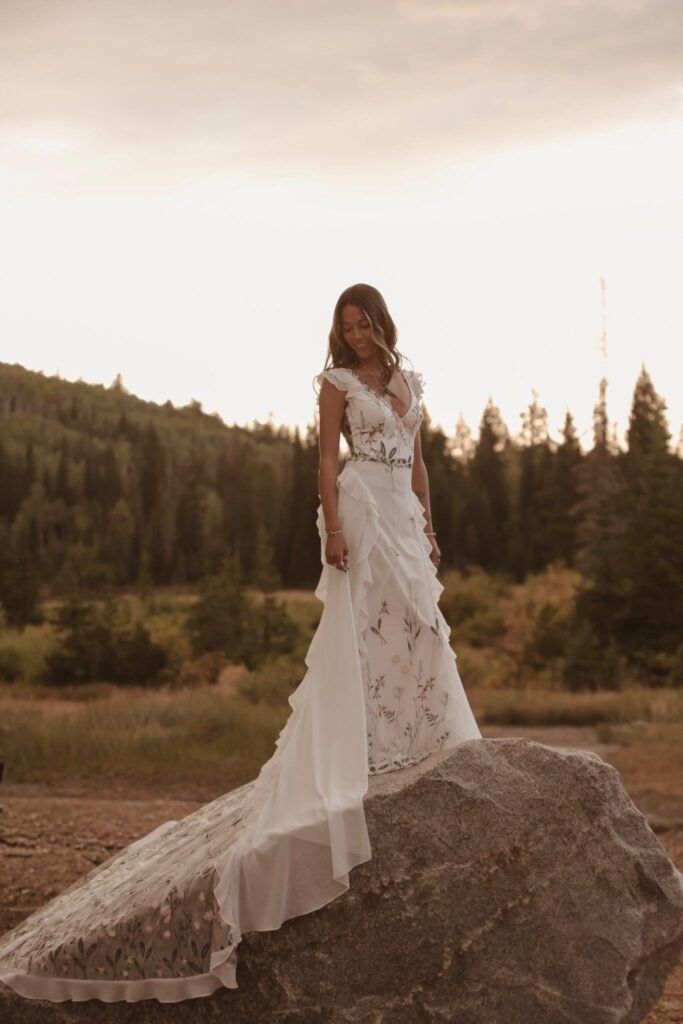
It is also the argument for a gown with something genuinely unusual in it. Cedar is cut in a branch-motif lace that you cannot read from across a field and cannot stop looking at from three feet away. Lily isn’t white at all, which more eloping brides choose than you would expect, since no one can explain it to you.
What does not change
Everything above is logistics. What matters most isn’t on the list, so I want to say it plainly.
Brides who elope are not opting out of being a bride. Nearly every one I have worked with wanted the full feeling of it: the dress, the moment she sees herself in the mirror, the photograph she will have on a wall in thirty years. She just did not want the apparatus. The seating chart, the performance, the audience.
So the one piece of advice I would push back on hardest is to keep it simple because the wedding is small. Choose the gown you would have chosen for three hundred people. Then check the closure, weight, fabric, and hem, and make sure it can get up the hill.
Where to start looking
Start with the conditions, not the silhouette. Where are you standing, how far are you walking, what is the weather doing, and who is helping you get dressed? Those four answers will eliminate more than half of what you are looking at and leave you with dresses you can actually wear that day.
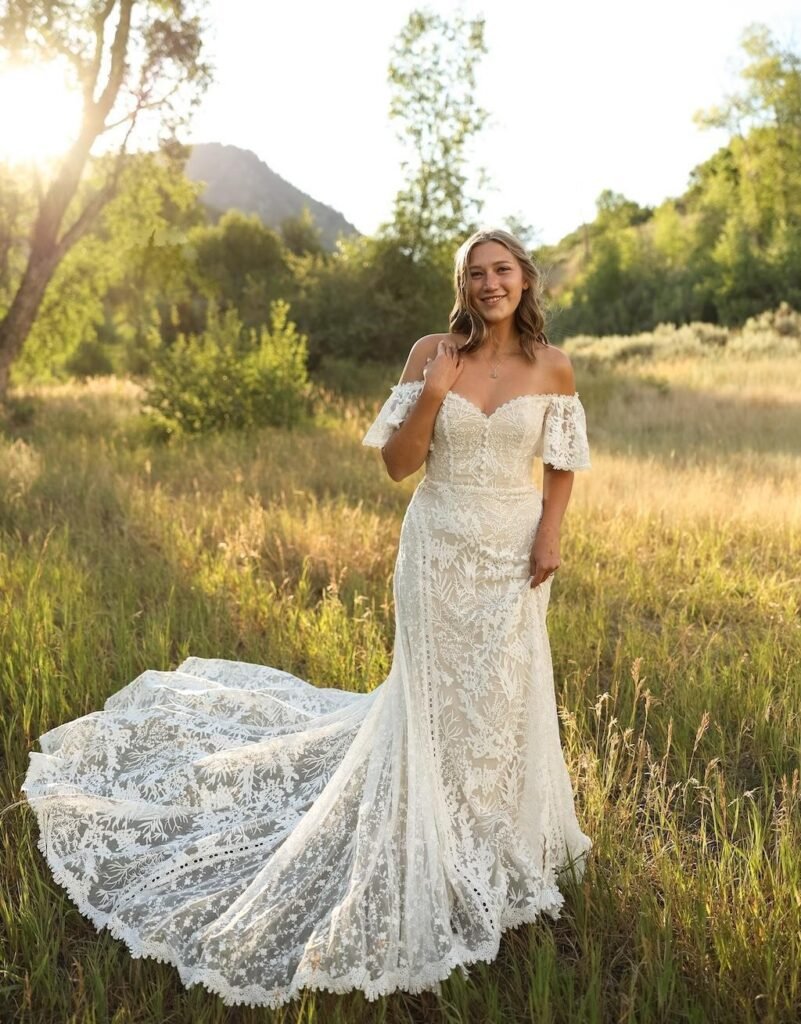
If you want a place to begin, our dresses made for eloping are cut with those four questions already answered. Ruth is the one I recommend most often to brides eloping outdoors, because the off-shoulder neckline stays where you put it and the skirt moves without weighing anything.
But the questions matter more than the collection. Ask them of whoever you buy from.
Yanique Barnes is the founder and designer of Dreamers & Lovers, a California bridal atelier making handmade cotton lace gowns since 2012.